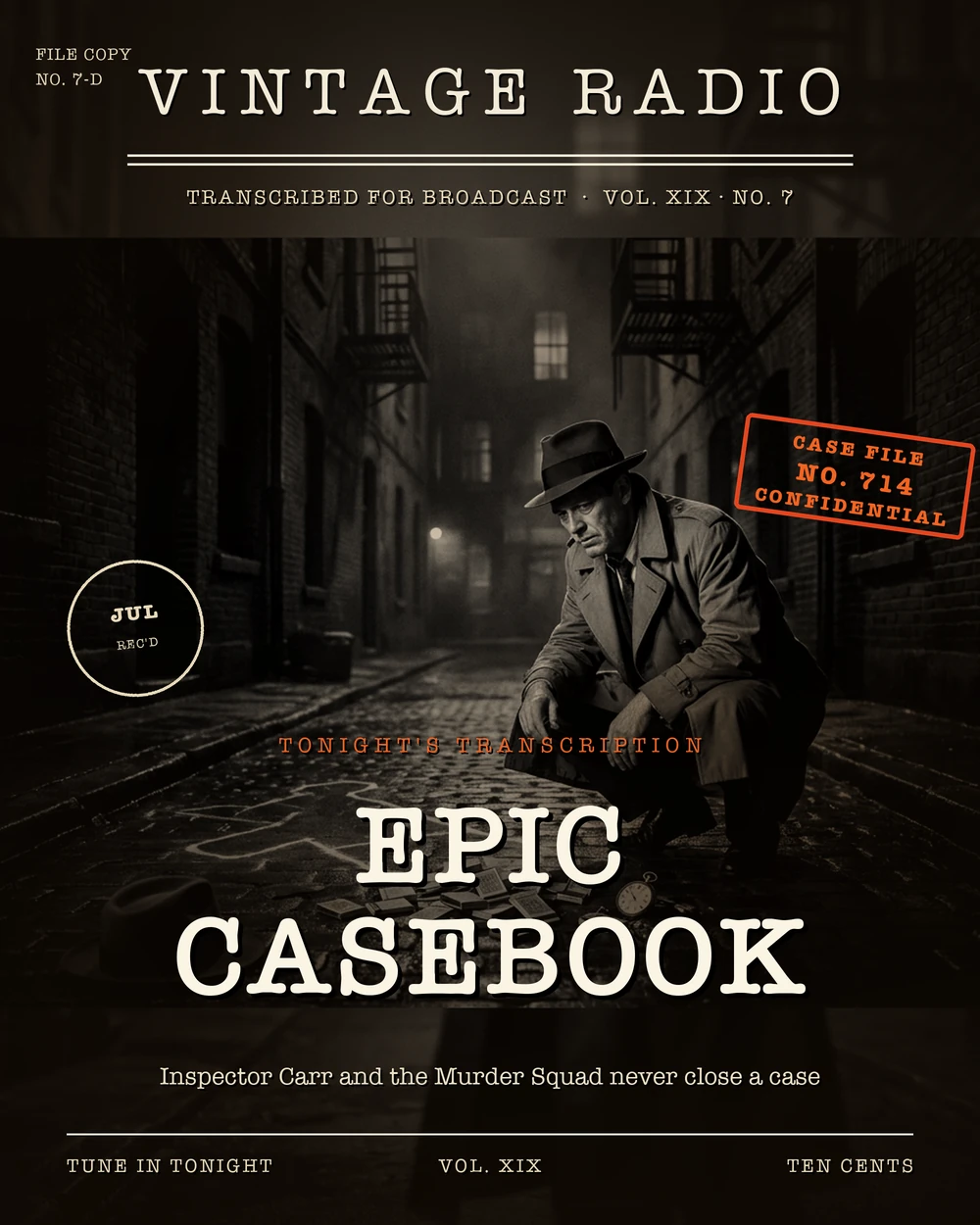
Epic Casebook
South Africa's Own Radio Detective
Most old-time radio detective shows came out of New York or Hollywood. Epic Casebook — full title The Epic Casebook of Inspector Carr — came out of Johannesburg. Produced at CRC Studios and broadcast on Springbok Radio, South Africa's first commercial radio station, the series ran from 1957 to 1985: twenty-eight years of Thursday-evening mysteries, each one introduced by the show's recurring tagline, …in which Inspector Carr investigates… That kind of longevity puts it in rare company anywhere in the world, let alone for a locally produced drama on a single national commercial network.
Springbok Radio had launched on 1 May 1950, broadcasting bilingually in English and Afrikaans from Johannesburg. By the time Epic Casebook debuted in 1957, the station had established itself as the home of South African commercial entertainment radio, and Inspector Carr of the Murder Squad became one of its most durable fixtures. The show was written and produced throughout its run by Michael Silver, whose consistent creative hand goes a long way toward explaining how a weekly whodunit stayed coherent across nearly three decades.
How the Formula Worked
Inspector Carr operated as a pure whodunit. Each episode followed a fixed structure: Carr, called in to investigate a murder under unusual circumstances, narrated his own investigation as he moved through it — questioning suspects, turning over evidence, building toward a confrontation with the killer that ended in a confession. Then, after the final station break, came the fourth-wall moment that gave the show its signature texture: Carr turned to the listener and asked whether they had spotted the one clue that gave the murderer away, then revealed what it was.
That closing beat was both a game and a promise. It told the audience that every episode was fair-play mystery — the clue was there, buried in the narration, available to anyone paying attention. It also made listeners active participants rather than passive ones, which was smart radio. Inspector Carr had no regular partner or sidekick, and no recurring arch-enemy; villains varied from episode to episode, which kept the formula from going stale. The only constant was Carr himself, moving through a fresh set of suspects each week.
The episode titles alone suggest the show's flavor: Death on the Counterfoil, Conjurer's Illusion, Threads of Death, The Clue That Never Was, Murder in the Bag. These are titles in the classic British whodunit tradition — precise, slightly theatrical, promising a puzzle rather than just a chase.
The Actor Who Owned the Role
The first Inspector Carr was Don Davis, who originated the part when the series launched. In 1959, Hugh Rouse took over the role, and it was Rouse who became most closely identified with the character for the remainder of the run. Davis returned briefly in 1963 for fourteen episodes, but Rouse reclaimed the part and held it through to the series' end in 1985.
Rouse was born in Brentford, Middlesex, on 17 January 1920, and joined Springbok Radio in 1958 — essentially stepping into the Epic Casebook role almost immediately after arriving at the station. Over the course of his career there he became one of the most familiar voices in South African broadcasting, narrating the South African radio adaptation of The Avengers from 1971 to 1973 and appearing in The Sounds of Darkness from 1967 to 1974. His voice carried a kind of British authority that suited the classic detective format — measured, precise, and at home with the genre's conventions. He died in Alberton, Gauteng, on 17 May 1998.
Inspector Carr as a character existed only in audio. He never appeared in print form; the series lived entirely in Silver's scripts and in the performances that brought them to Springbok Radio's audience each Thursday at 21:30.
The Sponsor and What Changed When It Left
For most of its run, Epic Casebook was sponsored by the Epic Oil Company of South Africa — the connection that gave the show its name. Epic Oil manufactured a range of consumer food products: Epic Pure Sunflower Oil, Purine and Predd Cooking Fat, Yum Yum Peanut Butter, Maple Margarine, and Niblets Cheese Twists. It was a practical domestic-goods sponsor for an evening drama aimed at a home audience, and the arrangement held for roughly twenty years.
When the Epic Oil Company's sponsorship ended in 1977, the series couldn't keep the name. It was renamed Inspector Carr Investigates and moved from its long-standing 21:30 slot to an earlier time slot of 20:30. The rename acknowledged what the audience already knew — that the character, not the sponsor, was the real draw — while the earlier time slot reflected shifts in Springbok Radio's schedule as the broadcasting landscape in South Africa changed during the late 1970s. The series continued under the new name until June 1985, when Springbok Radio cut its evening broadcast hours and the show came to an end.
The Television Attempt
In the early 1980s, the SABC produced a short-lived television adaptation with Michael McCabe playing Inspector Carr. The transition from radio to television was considered unsuccessful, and that verdict isn't surprising in retrospect. The show's entire structure depended on audio narration — Carr's voice guiding the listener through an investigation, planting the one clue within the flow of spoken words, then breaking the fourth wall at the end to address the audience directly. Those techniques are native to radio. On television, with cameras and sets and visible actors, the fourth-wall address becomes awkward and the embedded clue has to operate differently. The formula that worked for twenty-eight years on Springbok Radio didn't survive the translation.
The radio version's longevity and the television version's failure together make the same point: Epic Casebook was a radio show in the deepest sense, built around what the medium could do and not easily transferable anywhere else. Ten episodes from the series survive in the catalog, a small but representative sample of a production that ran for hundreds of installments across nearly three decades of South African broadcasting.